CS 2000 - Spring 2026.
[Home]
Welcome to CS 2000! 2/11/2026
Video of the Day
Python: list comprehensions from Socratica (fixed)
map, filter, and reduce
Booleans
Numbers (version 3)
Dictionaries
text files
Regular Expressions
urllib
Classes and Objects
Prime Numbers
Logical problem of the day
How many software engineers does it take to change a light bulb? And why?
How many Windows engineers does it take to change a light bulb? And why?
How many quality assurance testers does it take to change a light bulb? And why?
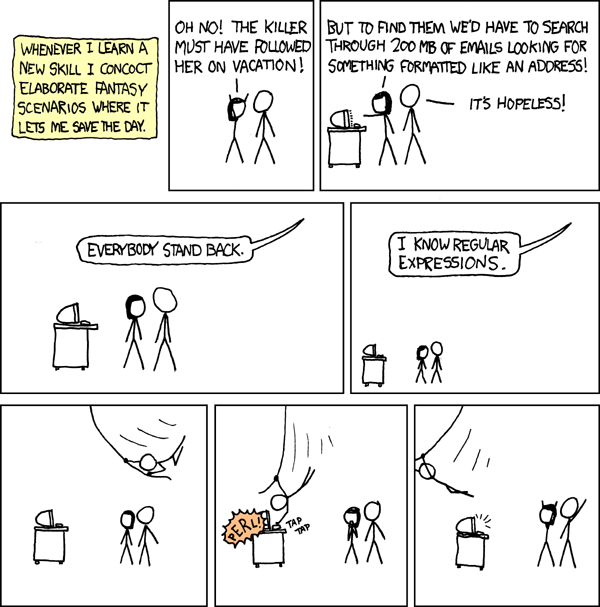
regex tshirt
regex cheat sheet tshirt
Linux cheat sheet tshirt
Using grep and the file linux.words in the lectures directory, what
regular expression would find all words that contain exactly two
x's? (There are 66 such words.)
https://pollev.com/slade
You may also download the app to your phone. Use the "slade" poll id.
Canvas Quiz of the Day (need daily password)
Most days, there will be a simple canvas quiz related to the lecture.
You need a password to activate the quiz, which I will provide in class.
These quizzes will count toward your class participation grade.
The quiz is available only during class.
Click for today's quiz. Note: to reward attendance, in-class quizzes are now worth 5 homework points.
Python Module of the Day
random. Here is a sample program:
myrandom.py.
See Pseudorandom number generator (PRNG).
There are hundreds of Python modules. Going
forward, I invite students to present their own selected Python module
of the day, along with some sample code. Send me an email. Students
whose submissions are selected will present their modules in class and
earn 5 extra homework points.
Lecture 8: Python.
Administrivia
I have office hours Mondays and Wednesdays from 2:30-3:30pm pm, on zoom, id 459 434 2854.
ULA office hours are found at
Ed Discussions on Canvas
Epigrams in Programming, Alan Perlis.
Homework assignments:
[Assignments]. hw3 is now
available. Extension for hw2 to February 13. (Fixed in Gradescope.)
Announcements
Let us know if you have an upcoming event you would like to
share with the class.
You may provide mid-semester feedback on canvas starting February 16th
and ending February 23rd. It is anonymous.
Midterm Exam
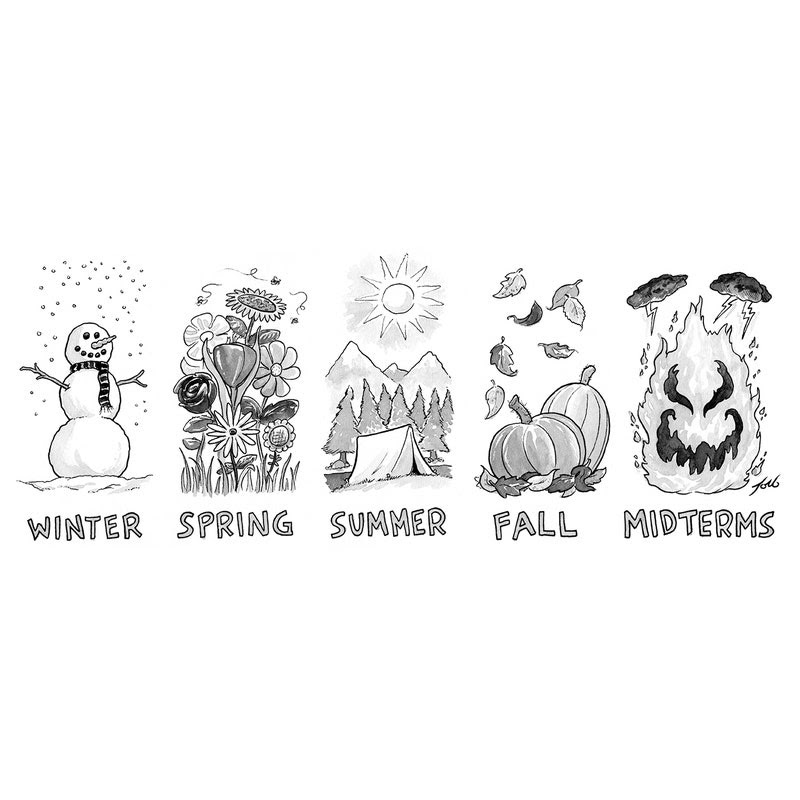
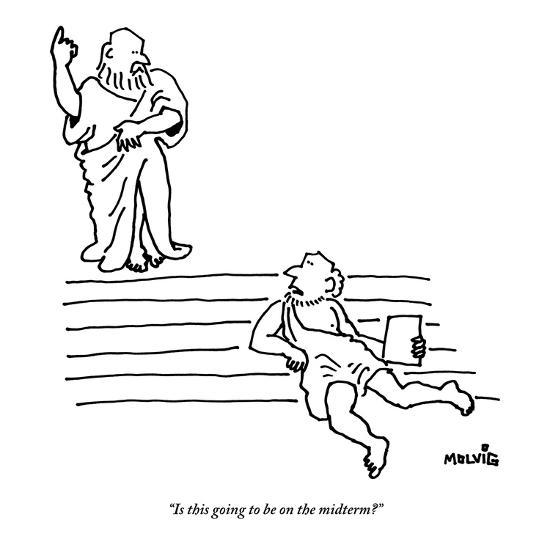
In 2022, the New Yorker ran the above cartoon. At first, I thought it
referred to our exams.
The midterm will be Thursday February 26th at 7pm in DL 316. It will be
a 2 hour hand written exam. No computers. No notes. No books. No
kidding. Students registered with Student Accessbility Services will
take the exam in room KT 219.
Here is a practice exam.
(solutions).
Practice UNIX script. (UPDATED)
(solutions).
mt.py code for practice midterm
Here is a great resource to practice regular expressions
https://regex101.com/ Also, see www.regular-expressions.info which has a tutorial as well
as useful examples, including HTML tags, email addresss, IP addresses, dates,
credit cards, and lots more.
Also, check out Regular Expression Crosswords
Also, the paper Music and Computation, discussed
below, is also in scope, up to but not including Music.
There will be true/false questions about binary encodings of numbers, text, images, and sound. No questions about music.
Sophia will host a review session. Tentatively, Friday February 20th, 2-5pm.
Getting to know Python
Review hw2. depth. os.stat(file) for biggest_file()
Everything is bits!
Music and Computation, discusses
the spectrum of binary encoding. It will be on the first midterm exam, except for the music part.
Object Oriented Programming
Oop.html (jupyter) object oriented programming.
F String Formatting
Getting to know UNIX
Esoteric Programming Languages
Standard UNIX file system root directories:
- /bin: Essential command binaries
- /boot: System boot loader files
- /dev: Device files
- /etc: Host-specific system-wide configuration files
- /home: User home directories
- /lib: Shared library modules
- /lib32: Shared library modules - 32 bit versions
- /lib64: Shared library modules - 64 bit versions
- /media: Media file such as CD-ROM
- /mnt: Temporary mounted filesystems
- /opt: Add-on application software packages
- /proc: Interface to kernal data structures
- /root: Home directory for root user
- /run: Run-time program data
- /sbin: System binaries
- /srv: Site-specific data served by this system
- /tmp: Temporary files
- /usr: Unix System Resources
- /var: File that is expected to continuously change
UNIX Introduction Principle 2.
[Home]