CS 2000 - Fall 2025.
[Home]
Welcome to CS 2000! 9/29/2025
Video of the Day
Socratica Python videos:
Logical problem of the day
What day of the week does NOT end in the letter Y? It's not "tomorrow".
(My daughter
Alexandra solved this problem when she was three.)
https://pollev.com/slade
You may also download the app to your phone. Use the "slade" poll id.
Canvas Quiz of the Day (need daily password)
Most days, there will be a simple canvas quiz related to the lecture.
You need a password to activate the quiz, which I will provide in class.
These quizzes will count toward your class participation grade.
The quiz is available only during class. Note: each quiz is now worth 5 points.
Click for today's quiz.
Lecture 9: UNIX / Python.
Administrivia
I have office hours Wednesdays from 4-6 pm, on zoom, id 459 434 2854.
I will be available for lunch on Mondays at 1 pm in Morse.
ULA office hours are found at
Ed Discussions on Canvas.
CS Peer Advisers.
Fall 2025 Peer Advisors Office Hours Schedule.
Homework assignments:
[Assignments]. hw3 is now
available.
Python Tutor
Announcements
Every Law Firm Should Build Their Own AI, Yale Professor Says, Bloomberg News.
Yale Information Society Project See this week's events. Need to register.
Office of Career Services
STEMConnect Pop Up advising Fall schedule. Drop in to one and have your resume reviewed, hear advice about finding internships, and learn more about how to get connected to alumni for networking opportunities.
Master's Degree in Personalized Medicine and Applied Engineering.
See flyer
The Yale School of Engineering and the Yale School of Medicine are
hosting information sessions for their innovative one-year joint
master’s degree in Personalized Medicine & Applied Engineering. Please
share the information below to your students, advising programs, and
student organizations.
This interdisciplinary program equips students with cutting edge skills at the intersection of medicine, engineering, and computer science. Participants gain hands-on experience designing 3D solutions for personalized healthcare using technologies such as 3D imaging and printing, artificial intelligence and machine learning, robotics and computer-assisted navigation, and augmented and virtual reality (AR/VR). Graduates will be prepared to develop customized medical interventions that enhance patient outcomes and drive innovation in clinical practice.
Who Should Apply:
Pre-med and medical students, biomedical/mechanical/electrical engineering and computer science majors passionate about healthcare innovation
Program Highlights:
- Interdisciplinary Courses: Co-taught by faculty from both Yale Engineering and Yale Medicine
- Thesis Projects: Applied research in fields such as orthopedics, cardiovascular medicine, oncology, tissue engineering, sports medicine, radiation oncology, and machine learning
- Clinical Immersion: Shadowing opportunities across 25+ specialties, including surgery, radiology, neurology, cardiology, anesthesiology, and pediatrics
- Customized Curriculum: Flexible course selection tailored to each student’s academic background and career goals
More details are on our website seas.yale.edu/pmae.
Applications Open: September 15
Join an upcoming informational Zoom Session (registration link):
- Tuesday, Sept. 30, 6:00 pm EDT https://yale.zoom.us/j/97584615181?from=addon
- Friday, Oct. 24, 1:30 pm EDT https://yale.zoom.us/j/93666356156?from=addon
- Tuesday, Oct. 28, 6:00 pm EDT https://yale.zoom.us/j/98100560693?from=addon
- Wednesday, Nov. 19, 7:00 pm EST https://yale.zoom.us/j/94992022856?from=addon
- Wednesday, Dec. 3, 7:00 pm EST https://yale.zoom.us/j/96348713738?from=addon
For questions, please contact:
Dr. Daniel Wiznia (daniel.wiznia@yale.edu) and Dr. Steven Tommasini (steven.tommasini@yale.edu).
More information and application details can be found on our website.
Midterm Exam

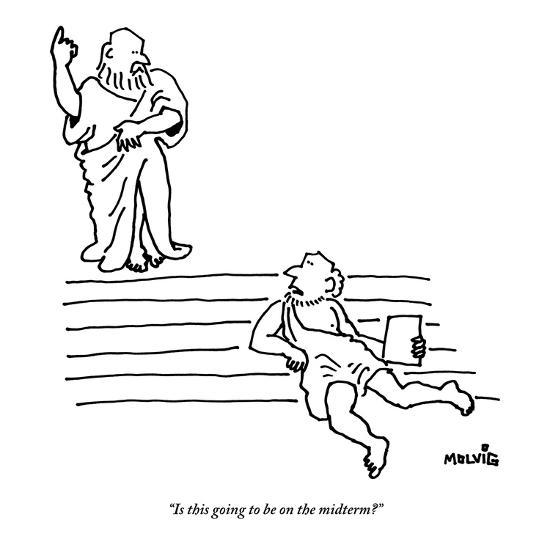
In 2022, the New Yorker ran the above cartoon. At first, I thought it
referred to our exams.
The midterm will be Thursday October 9 at 7pm in DL 220. It will be
a 2 hour hand written exam. No computers. No notes. No books. No
kidding. Students registered with Student Accessbility Services will
take the exam in room ML 211, across the street.
Here is a practice exam.
(solutions).
Practice UNIX script.
(solutions).
mt.py code for practice midterm
Here is a great resource to practice regular expressions
https://regex101.com/ Also, see www.regular-expressions.info which has a tutorial as well
as useful examples, including HTML tags, email addresss, IP addresses, dates,
credit cards, and lots more.
Also, the paper Music and Computation, discussed
below, is also in scope, up to but not including Music.
There will be true/false questions about binary encodings of numbers, text, images, and sound. No questions about music.
Here is the document without the music section: Binary Encoding. Try this prompt with your favorite AI bot: Using the document found at https://zoo.cs.yale.edu/classes/cs200/lectures/BinaryEncoding.pdf please generate 20 sample true or false exam questions.
Note: today the bots complain that they cannot load web files. Let me know
if you find a way around this. In the mean time, I sent you 100 sample T/F questions on Friday.
Getting to know Python
Requests.html (jupyter) Python - Requests - a better way
to process web pages, plus Beautiful Soup.
hw2 review. - biggest file. Note from Ed Discussions:
You may use os.stat() to get the size of a file or directory. It
returns a tuple, the 7th element of which is size, that is,
element[6]:

bs5@giraffe:~/cs200/www/lectures/newdir$ pwd
 /home/accts/sbs5/cs200/www/lectures/newdir
 sbs5@giraffe:~/cs200/www/lectures/newdir$ ls -l
 total 0
 -rwxr--r-x 1 sbs5 faculty 6 Sep 22 15:38 goodbye
 -rw-rw-r-- 1 sbs5 cs200ta 6 Nov 1 2023 hello
 -rw-r--r-- 1 sbs5 cs200ta 12 Sep 25 08:35 high
 sbs5@giraffe:~/cs200/www/lectures/newdir$ stat high
 File: high
 Size: 12 Blocks: 0 IO Block: 65536 regular file
 Device: 0,57 Inode: 3763202446 Links: 1
 Access: (0644/-rw-r--r--) Uid: (10379474/ sbs5) Gid: (63533/ cs200ta)
 Access: 2025-09-25 08:35:15.879848000 -0400
 Modify: 2025-09-25 08:35:30.394796000 -0400
 Change: 2025-09-25 08:35:30.394796000 -0400
 Birth: -
bs5@giraffe:~/cs200/www/lectures/newdir$ p
Python 3.12.3 (main, Aug 14 2025, 17:47:21) [GCC 13.3.0] on linux
Type "help", "copyright", "credits" or "license" for more information.
>>> import os
>>> os.listdir()
['hello', 'goodbye', 'high']
>>> os.stat('high')
os.stat_result(st_mode=33188, st_ino=3763202446, st_dev=57,
st_nlink=1, st_uid=\ 10379474, st_gid=63533, st_size=12,
st_atime=1758803715, st_mtime=1758803730, s\ t_ctime=1758803730)
>>> os.stat('high')[6]
12
Here is how I originally solved the problem. This is the current staff solution. Don't do this,
but figure out how it works.
def biggest_file(dir):
  tempfile = '/tmp/biggest'
  cmd = 'ls -l ' + dir + " > " + tempfile
  # print( "Command to run:", cmd )
  status = os.system(cmd)
  # print ("status: " + str(status))
  if status:
      # print ( "Error in executing command: " + cmd)
      return '*** error reading ' + dir
  size = 0
  name = ''
  for line in open(tempfile, 'r'):
      fields = line.split()
      # print (fields)
      if len(fields) == 9:
          s = fields[4]
          n = fields[-1]
          if int(s) > size:
              size = int(s)
              name = n
  os.remove(tempfile)
  return ( name )
Everything is bits!
See Music and Computation.
Object Oriented Programming
Oop.html (jupyter) object oriented programming.
F String Formatting
Getting to know UNIX
UNIX Introduction Principle 2.
[Home]