CS 370 - Spring 2025. 1/22/2025
[Home]
Welcome to CS 370!
Video of the Day
20,000 gallons of tech space, submitted by Tyler Schroder.
Prof. Rebecca Kramer-Bottiglio’s group is behind these. Autonomous
robotics (AI assisted as I understand it) with the ability to traverse
multiple environments and seamlessly move between them.
A group of us from Professor Wittenstein‘s Schmidt program got to
visit and see a live demo last semester.
I hereby solicit suggestions for the video of the day. Please email
me your ideas with explanations. Selected entries will win 5
homework points. If your video is played at the beginning of class, you must also
briefly explain something about the video and something about yourself - in person.
Canvas Quiz of the Day (need daily password)
Most days, there will be a simple canvas quiz related to the lecture.
You need a password to activate the quiz, which I will provide in class.
These quizzes will count toward your class participation grade.
The quiz is available only during class. You get full credit for
class participation by completing half of the quizzes.
Click for today's quiz.
Lecture 3: HW0, Python, Jupyter
Announcements
The Communications
of the Association for Computing Machinery (CACM)
is the monthly publicatio of the ACM. The ACM is
the major professional society for the broad field of computer
science. I have been a member for 50 years now. If you intend
to pursue a career in computer science, either in industry or
academia, you should join. They have a special student membership
rate of $19 a year. See https://services.acm.org/public/fall/ and select ACM Student Membership. If you sign up (or are already a member), I will award you
5 homework points. Just send me proof.
Administrivia
I have office hours Wednesdays from 4-6 p.m. via Zoom, meeting ID
459 434 2854.
The TF's office hours are posted on Ed Discussion.
I am available for lunch on Mondays at 1 pm in Franklin.
If you're thinking of taking
CPSC 370, please do the following.
Complete
this online Student Information form.
You should have a course account for CPSC 370 on the Zoo.
Start the homework assignment:
[Assignments]. hw0 is a Python refresher. hw1 is now available as well.
There was a question on Ed Discussions about the midterm to which I responded:
The midterm will largely be questions like the book exercises. See
https://aimacode.github.io/aima-exercises/
I will provide a practice exam with solutions. The scope of the midterm is through chapter 9.
Lecture: Cognitive Science, HW0, Python, Jupyter Notebooks
AI in the news
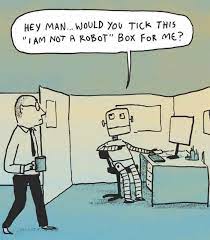
‘No, I’m not a robot’: ChatGPT successor tricks worker into thinking it is human, article submitted by Amy Metrick. Note: CAPTCHA stands for Completely Automated Public Turing test to tell Computers and Humans Apart.
It raises the question of when is it OK for a computer to lie. We
will return to this later.
The Next Robot Invasion NYT article about AI at the Consumer
Electronics Show (CES).
Summit AI
Coach. Described in Bloomberg
article 1/17/2025. If you try it out, let me know how it goes. I
don't need an AI coach. I am married.
Searle
You are familiar with the
Turing Test for AI, aka, the imitation game, which is often dismissed these days. The Turing
Test was largely replaced in the academic community by Searle's
Chinese Room, which
was inspired by a 1979 visit to the Yale Artificial Intelligence Lab.
As I mentioned, Searle was "me-too'd". In 2017, he was charged with sexual
harassment and eventually cancelled. Also, I should point out that the
whole "Chinese Room" argument is racist.
Modern AI and Classic Yale AI are two perspectives.
There is a dualism to modern, statistical AI versus classic, Yale cognitive
science approach. Sometimes called
GOFAI (Good old-fashioned AI).
You may view them in Hegelian terms of thesis and antithesis. In
this course, we argue for the synthesis, also known as neuro-symbolic AI.
Other dimensions of the
duality include
- orthodox vs iconoclastic.
- respectful vs irreverent.
- quantitative vs qualitative.
- neat vs scruffy. (Abelson's terms. It is of interest that Abelson was
a world class statistician. Yet, he was attracted to qualitative.)
CS 370 Thought Experiment Please complete. Take your time. Be
introspective. The purpose of this is to get you thinking about the
topics, not to find the correct answer. Think about these questions
in background for several weeks. We will return to this topic later
in the term.
Python and Jupyter Notebooks
CS 200 covers Python in depth. See Python jupyter notebooks for CS 200. Everything up to the PVM is in scope for CS 370, plus the machine learning
notebook.
Hints from Effective Python, chapter 1.
Jupyter notebooks (2014)
- Per the questionaire, most of you are familiar with Jupyter notebooks.
- Literate
Programming, Donald Knuth, 1984. He called the system
"WEB", since he believed that it was one of the few
three-letter words of English that had not yet been applied to
computing. Also known as notebook interface.
- jupyter.org Main site.
- Jupyter Notebook Tutorial: Introduction, Setup, and Walkthrough YouTube.
- Jupyter Notebook Cheat Sheet
- The jupyter notebooks from the textbook and the class
are on the zoo at
/c/cs370/www/aima. The zoo
machines run the X Windows system which supports
exporting the display. Normal ssh does not
handle this. If you have a mac, you need an X Windows
version of terminal, namely, XQuartz. If you
have a windows machine, you need MobaXterm.
If you happen to have a LINUX machine, you can
run ssh -Y. The -Y option enables remote
graphics display.
- An easy way to test remote graphics is running xclock &
on the zoo machine, once you have connected with Xquartz or mobaxterm or ssh -Y.
- You can also login directly to the zoo workstations on the third
floor of AKW (6 nodes) or the first floor of 17 Hillhouse, room 111 (12 nodes).
Intelligent Agents
Slides: 2019 Intelligent Agents These slides are from Professor Scassellati.
Eliza in emacs: meta-x doctor
POMDP Partially Observable Markov Decision Processes.
MDP + HMM = POMDP (Chapter 17 of AIMA)
ALIVE (Artificial Life Interactive Video Environment)
Slides: AIMA chapter 2 uses LISP. From Russell at Berkeley.
6 up
agents.html agents jupyter notebook, from Norvig.
You need to understand this code and its
related python modules to tackle hw1.
hw1.html is now available: vacuum cleaner world! hw1.html (from jupyter notebook)
[Home]